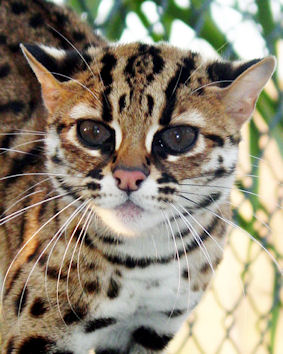
What is a Bengal?
The Bengal is a hybrid cat, resulting from the crossing of a domestic cat with an Asian leopard cat (ALC). The name Bengal doesn't apply to the cat until the 4th generation, when they are considered to be stable and domesticated. Pet Bengals are wild in looks, but not in personality. This breed is alert, energetic, active, muscular and intelligent. They usually get along wonderfully with other family pets.
How big do Bengals get?
Today most Bengals are about the size of a large domestic cat. Female Bengals average from 7 to 11 pounds at maturity, while the more heavily muscled males can average from 11 to 18 pounds at maturity.
They are well known
for their beautifully spotted
or marbled coats with high contrast between the pattern and
background colours. Bengals
come in two coat patterns, spotted and marbled. The spotted should
be formed in a random and horizontal pattern rather than vertical.
Rosettes are preferred over plain spots but good contrast is more
important. The marbled pattern should flow horizontally, and should
resemble marble. Their
colours come from the wild--black, brown or rust on bright shades of
tan, gold or mahogany. Like its wild counterpart, a white version of
the Bengal is called a snow. The preferred pattern is leopard spots,
not tabby stripes, on legs and ribs. Ivory-to-white undersides and
small, rounded ears also are desirable.
What are their temperaments like?
Temperament is of a major concern, both to breeders and to pet buyers. Today carefully bred Bengal kittens from reputable breeders have loving, outgoing personalities. The instinctive suspicion of the wild cat has been bred out through careful selection. The two main things breeders look for are sweet temperament and a beautiful, wild appearance. First-cross (F1) hybrids are often shy, nervous, untouchable cats, much like their wild ancestors. Like mules, first-generation hybrid Bengal males are infertile, but their F1 sisters can reproduce. In subsequent generations, males are fertile so out crosses to domestic cats are no longer needed. In fact, they are undesirable because breeding back to domestics dilutes the wild inheritance.
Personality Traits
Well-bred
Bengals are affectionate, purr enthusiastically and are exceedingly
intelligent, a trait probably inherited from the wild cat's natural
selection for jungle survival. They use the litter tray, like to climb
and run, and are quick and curious about everything. Bengal owners
report that their cats retrieve, learn tricks and love water,
sometimes coming right into the bath or shower to play with human toes. When Bengals are excited, their tails fluff up into massive raccoon-like
tails. Even as
adults, Bengals are entertaining and playful, but as in other breeds
of domestic cats, they vary greatly in appearance and behaviour. In
general, skittish, fearful kittens seldom become affectionate pets,
but they may bond to certain family members. Bengal
kittens often go through an ugly stage of fuzziness between 2 and 6
months of age in which the clearly contrasted markings are spoiled
and blurry. This muting is probably nature's way of protecting the
young; baby cheetahs go through a similar fuzzy stage. Then,
depending on the seasons, the fuzzy coat falls out and the colouration
returns, unless, of course, the kitten was grey (tawny) at birth. All
Bengals must have a black tail tip, regardless of body colour. The
marbled has no counterpart in the wild, and in captivity no two
marbled Bengals are alike. The pattern may be sharply defined patches
of colour; reminiscent of a stained glass windows, or flowing,
twisting streams of clear colour.
Bengals are no different than any other domestic cat when it comes to
care and feeding. Female Bengals average from 7 to 11 pounds at
maturity, while the more heavily muscled males can average from 11 to
18 pounds at maturity. The pedigree Bengal cat can have many different colourings or markings
depending on it's breed line but most share a feature unique to
Bengal's, glitter. Glitter is defined as a hollow air shaft that
surrounds the colour on the hair. In a way the fur actually
"glitters".
Even the voice of a Bengal is different from that of other domestic cats. It has been described as a cooing or chirping or as a strange gravelly sound. They have a wide vocabulary that may on occasion be quite strident especially in unfamiliar situations. This should not be confused with aggression; it is an individual means of expression. Their vocals can vary from cat to cat but they are noted for a "yowl" sound. They can be very persuasive about this. The translation to our language is most likely, "You WILL do what I want now!". They also have an interesting chirping noise and a strong steady purr.
Nevaeh Bengal kittens for sale
are from stunning rosetted glittered Bengals.
Bengal Cattery &
Bengal Cat Breeder in Wiltshire with Bengal Kittens for sale.

© 2025 Nevaeh Bengals. All text and images are the intellectual property of Nevaeh Bengals. All rights reserved.